
During my first week as a summer intern at Infectious PR, I did a lot of research into how Spotify’s algorithmic playlists work. This highlighted the how the relationship between the artist and mediums through which they release their music can influence each other. For an up and coming artist creating music today, the prominence of streaming services and how they work can influence not just their marketing strategy and how they engage with their fans, but also the music-making process and decisions themselves.
The role of technology in the music industry stretches way back before streaming. When the gramophone record was the standard format of consuming music, it had a capacity of about 3-5 minutes per side. This physical limitation imposed a restriction on the length of a piece of music the artist could record.
Following from this, the 12 inch vinyl record could hold 44 minutes of recording in total across both sides. If an artist wanted to release an album longer than 44 minutes, they could do so via a double album release, but this was often discouraged by labels because it was considered less marketable. This is an example of how the nature of the music technology influenced the artist’s creative output.
Fast forward to today, and streaming dominates the music listening world. Spotify’s algorithms can be used by an artist and their team to boost the artist’s number of streams, translating into overall growth. There are many different elements and models to these algorithms, that all contribute to the user experience.
One example, is that a stream of a song only counts on Spotify if the user listens past the 30 second mark. This may influence the artist’s musical choices in that they may be swayed away from having a long introduction on a song, and towards making the song as immediately engaging as possible within the first few seconds.
Additionally, with access to an almost terrifying amount of music at our fingertips, the listener’s patience may have reduced, leading to them to favour shorter projects, as they don’t have the focus to sit and listen to an album that is over an hour long. The releases of albums produced by Kanye West in 2018 comes to mind, including his own 23-minute album ye, a 21-minute album DAYTONA produced for Pusha T, and a 22-minute album K.T.S.E. produced for Teyana Taylor.
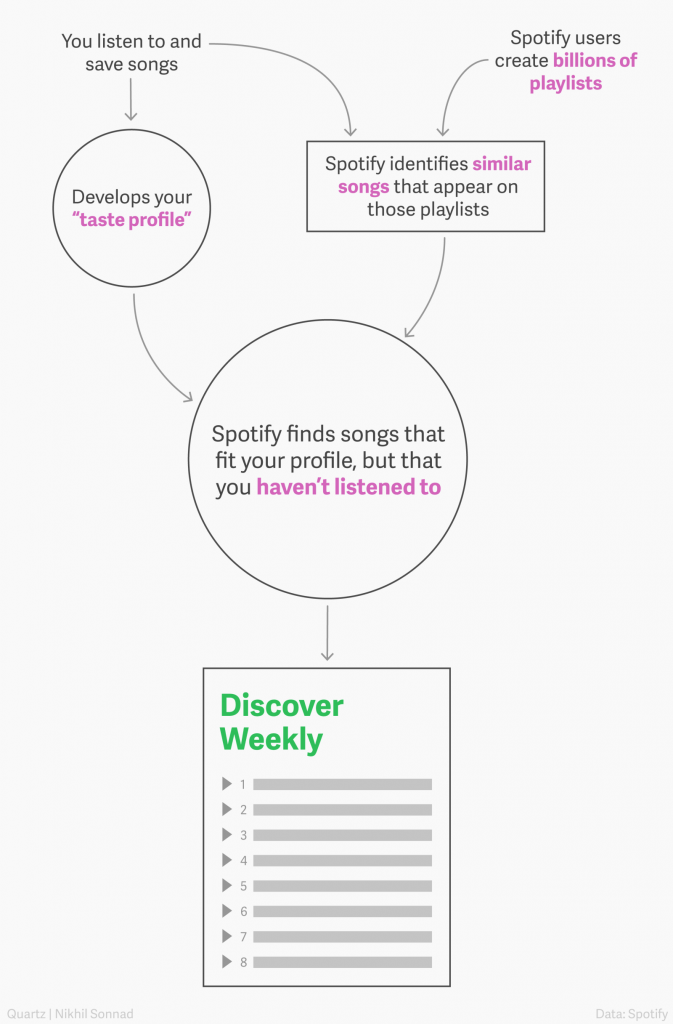
To give another example, one algorithm model that Spotify uses to create the user’s personalised Discover Weekly playlist, is they use all their user’s listening data to identify their tastes, and which users listen to similar artists. Put simply, if two users listen to similar artists, and User A listens to an artist User B doesn’t, then it is likely that artist will appear on User B’s discover Weekly. As well as tracking user activity, Spotify crawls everything on the internet, from social media to blogs to Wikipedia, to identify key words about each artist and which artists are typically associated with which genres and artists. The fact that streaming services operate in this way may encourage artists to create music that is similar to what is already popular, so that they can jump on these trends, make it onto the big playlists, and so on.
Some more avid music fans may feel disappointed at the thought that artists are creatively influenced by the way streaming services operate. Shouldn’t the artist be making the music they want to make, regardless of how it might be received, or how it fits into the current landscape? I certainly wouldn’t want my favourite artists abandoning their own music judgement in favour of pursuing a structure that will get them more streams from the algorithms.
Despite this, as I have shown, technology has always influenced musical creation, going back to gramophones and probably before. So perhaps it’s just one trend that will inevitably morph into another when the next big way of consuming music comes around. I am also hopeful that if an artist is truly creating great music, this will be picked up on, noticed, and loved even if it happens to have a super long introduction, or be very un-spotify-playlist-worthy.
 Stuck On Repeat with Leah
2 replies on “Algorithms and the Artist”
Thought-provoking indeed. Loved listening to my LPs as the daughter of an independent record shop owner. I never considered the limited capacity on a vinyl and how it could affect content in such a way. Things have certainly progressed for the better in that respect. Mum x
LikeLike
[…] is created, the nature of the music itself, and the distribution process (as I mentioned in my blog post last month!). However, Daniel Ek’s blanket statements completely undermines the value of […]
LikeLike